
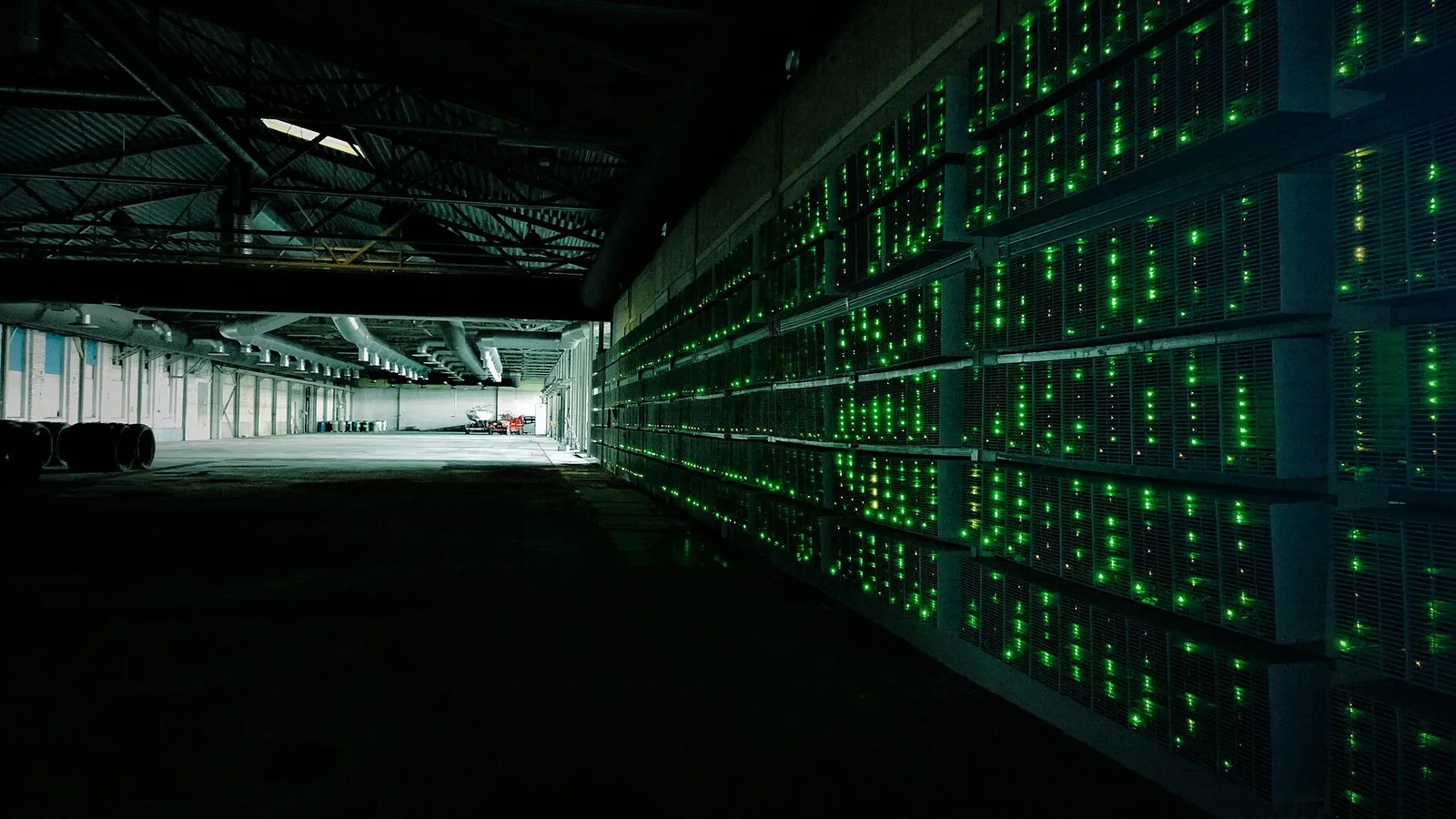
Bitcoin's mining difficulty fell below its year-earlier level in 2026 — only the second time in the network's history. The first was mid-2021, when China's mining ban took roughly half the network's computing power offline. Difficulty returned to record highs within months back then, once operators had relocated their equipment. This time the cause is different.
The figures
In early August 2026 difficulty stood at roughly 126.23 trillion hashes, about 14 percent below the year's high and 19.1 percent below the record. Estimated network hashrate hovered around 855 EH/s.
The decline came in two large steps. On 7 February 2026 difficulty dropped 11.16 percent to 125.86 trillion, after hashrate fell about 20 percent over the preceding month and average block times reached roughly 11.4 minutes. June brought a further 10.09 percent decline, from 138.96 to 124.93 trillion. Bitcoin had fallen about 15 percent that month, and the preceding difficulty epoch lasted around 15.6 days because blocks were being found more slowly.
The picture has since stabilised. The adjustment of 8 August 2026 turned mildly positive again at plus 0.99 percent, to 127.48 trillion. Block times have recently averaged 9 minutes 54 seconds.
The actual driver
Bitcoin difficulty normally rises over a twelve-month horizon as more efficient hardware enters service and higher prices make additional capacity profitable. A reversal means machines are leaving the network faster than new capacity can offset them.
The cited causes include weak mining economics, regional outages, Texas power curtailments, and policy or energy shocks across several mining hubs. The structurally most important factor, however, is a new competitor for the same resource: operators of AI and HPC data centres.
These operators reportedly pay three to twenty-five times more for electricity, pushing mining facilities toward conversion. For SHA-256 computing power this represents the first structural competitor for capital and electricity — unlike 2021, which was a regulatory displacement followed by a return.
Why this is not purely bad for remaining miners
A drop in difficulty reduces competition for blocks and therefore improves profitability for those who stay online. Surviving operators have upgraded to next-generation ASICs with hardware efficiency below 15 J/TH. These deployments mask part of the hashrate lost to AI data centres and have recently pushed difficulty back up to 127.3 trillion.
Some of that transition is funded by sales. Cipher Mining reported a quarterly loss of 300.6 million US dollars while liquidating 1,166 BTC to fund retrofits of its own data centres.
Not all balance sheets point the same way. Block Inc. reported a 31 percent year-on-year increase in Cash App Bitcoin gross profit for the second quarter of 2026, contributing to a company-wide adjusted operating margin of 27 percent.
The margin picture
Hashprice — expected miner revenue per unit of hashrate — stood at roughly 31.89 US dollars per PH/s per day in mid-August. At around 32 dollars, the figure sits at or below breakeven for many operators depending on operating costs and machine type. In June the figure had been 27.67 dollars.
In the week to 17 August, miners collected a total of roughly 3,178 BTC in block rewards, equivalent to about 201 million US dollars. Transaction fees accounted for just 0.69 percent of that, around 22 BTC or roughly 1.39 million US dollars.
That fee share is the model's quiet problem. After each halving of the block subsidy, the fee market is supposed to carry a growing part of miner compensation over the long run. At 0.69 percent, none of that is currently visible.
Putting it in context
Bitcoin traded at roughly 64,259 US dollars on 17 August 2026, down about 1.0 percent on the week and around 26.4 percent year to date. Crypto prices change continuously; the figures given refer expressly to the time of collection and are not current prices.
One point matters for interpretation: the Bitcoin price does not enter the difficulty formula. It acts only indirectly, through profitability and therefore miner participation. Inferring a price trajectory directly from falling difficulty confuses correlation with causation.
Nor is falling difficulty a security problem in the narrow sense. It means less competition among the remaining miners, not an attackable network. The adjustment every 2,016 blocks is precisely the mechanism that produces this rebalancing.
This article is for information purposes and does not constitute investment advice.